
CorriDraw for Marketing Teams: From Campaign Canvas to Launch
A field guide for marketers who think on whiteboards. Plan the campaign canvas, map the funnel with real numbers, line up the message house, and story-map the launch — all on one board your team can actually edit with you.
Priya Raman
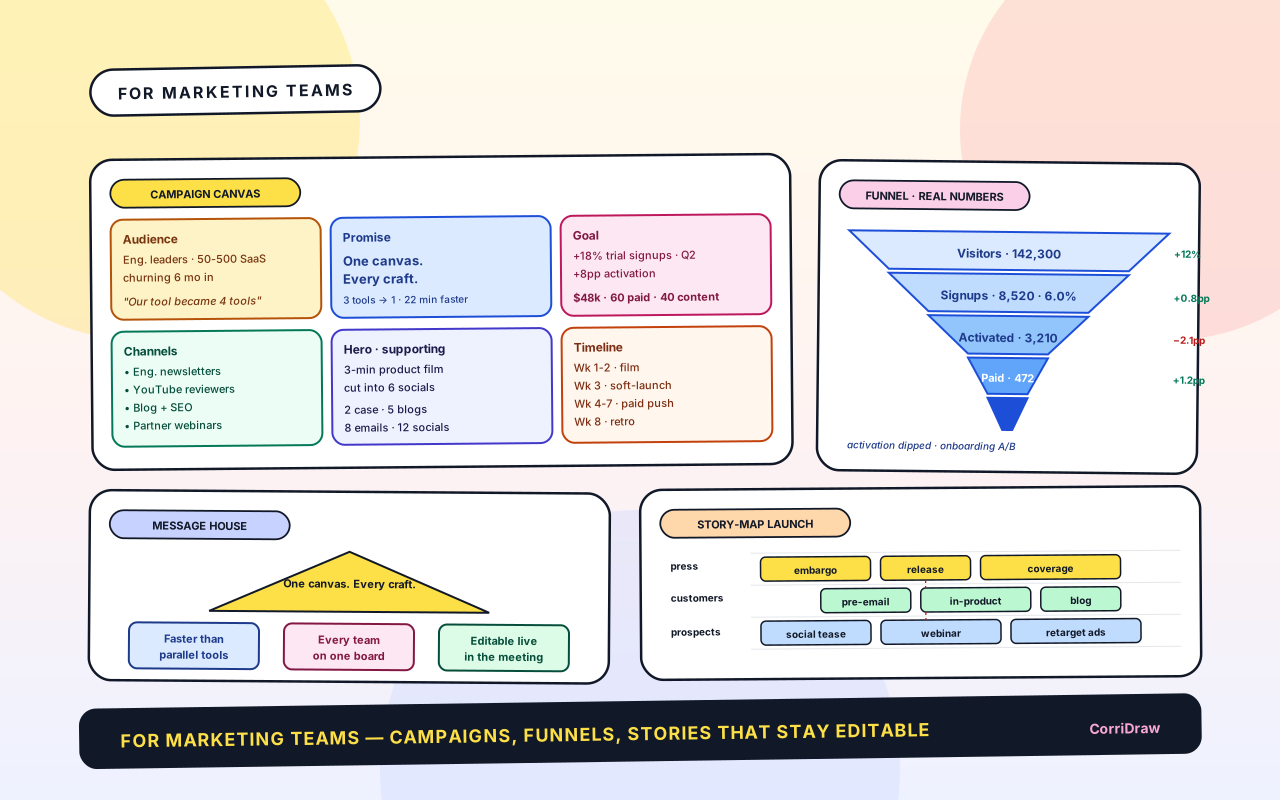
Marketing teams are slide factories. The plan is a deck. The funnel is a deck. The retro is a deck. Here are four canvases that replace the recurring slide rituals — campaign brief, funnel with numbers, message house, launch plan — and the practices that keep them honest.
The four canvases
- Campaign canvas — one page that holds a whole campaign's strategy and execution.
- Funnel with numbers — a real funnel, not a shape, with conversion rates and deltas on every step.
- Message house — the hierarchy of claims your team agrees to make publicly.
- Story-map launch plan — a Gantt-shaped narrative of who tells what to whom, when.
Each replaces a slide ritual everyone secretly hates. Each is editable live in the meeting. None has to be re-pasted into a deck for next week's review — the canvas is the review.
1. Campaign canvas
One page, six panels, every campaign starts here.
The discipline that keeps it real: every panel has to fit.
- Can't say who the audience is in two short lines? You don't know who the audience is.
- Single-minded promise needs three sentences? It isn't single-minded.
- Metric is "lots of growth"? That's the meeting you need to have now, before any money is spent.
The canvas kills the deck. Weekly review opens the canvas, not slides. Status = colour the timeline cell green/amber/red. Decisions = edit the panel. Ten weeks in, the canvas is a record of what the plan started as and what it became. No "v3-final-FINAL.pptx".
2. Funnel with real numbers
Most marketing funnels are slide shapes — five trapezoids labelled AWARE / INTEREST / DESIRE / ACTION / LOYALTY. Useful for explaining the concept once. Useless on Wednesday morning. The funnel that earns its place has counts, rates, and a delta against last period on every step.
Two affordances slides don't have:
- Annotate the steps. The −2.1pp on activation gets a sticky next to it: "started Mar 8 — coincides with onboarding A/B test, see Linear ENG-882". The number isn't a verdict; it's a question with a hypothesis attached.
- Thread campaigns to steps. Each campaign canvas has a line drawn to the funnel step it's meant to move. When the line lands on a step that didn't move, the campaign missed.
The funnel becomes the meeting's home. Growth reviews open it. New campaigns are scoped by pointing at the step they're trying to move. Retros run by checking whether the step actually moved.
3. Message house
A hierarchy of claims: one core message at the top, three to four pillars below, a handful of proof points under each pillar. Borrowed from PR practice. Nothing the team says publicly should drift outside the house.
Why it matters: marketing speaks to the world through dozens of mouths — social, founder posts, sales deck, help-centre copy, webinar host. Without a house, mouths drift. With a house, drift is visible: copy that doesn't ladder up to a pillar gets flagged in review — not because it's wrong, because it's off-message.
Add one column to the right of the canvas: which proof points are evidenced and which are aspirational.
- Green — there's a customer story or a number behind it.
- Amber — true but unproven.
- Red — we say it but secretly can't back it up.
Red proof points are a backlog for customer marketing — not lies, requests for case studies that don't exist yet.
4. Story-map launch plan
A launch is a sequence of stories told to a sequence of audiences. Press hears it before customers; customers before prospects; prospects before the cold market.
Draw it as a story-map on a Gantt backbone (see Gantt Charts 101) — rows are audiences, columns are weeks, cells are the asset that lands in that audience that week:
- Press row: embargo → press release → coverage.
- Customer row: pre-announce email → in-product banner → blog post.
- Prospect row: social tease → demo webinar → retargeting ads.
The art is in the dependencies. The press release and the customer email have to land within an hour or customers feel ambushed by their own product launch on Twitter. The webinar follow-up email has to go out same-day or leads decay. Draw those dependencies as arrows on the canvas; the launch lead checks the arrows on Monday morning. Anything missed is visible in the geometry, not buried in someone's calendar.
Why the slide factory persists — and how to break it
Slides are shareable; editable formats are scary. A deck is a frozen artefact you can email; a canvas might be different in five minutes. Two practices defuse the fear:
- View-only export. Generate a time-stamped PDF or PNG on demand and attach it to the email when stakeholders want a frozen view.
- This-week's-status stripe. Three sentences across the top of the canvas, written by the campaign owner each Friday. The leadership update is a screenshot of that stripe.
The work happens on the canvas; the report happens at the top of the canvas. Decks become rare — and most of them turn out to have been theatre.
Try this on your next campaign
- Open a fresh board. Draw the six panels of the campaign canvas. Force every panel to fit.
- Pin it next to the funnel-with-numbers.
- Draw a line from the campaign to the funnel step it's trying to move.
- Four weeks in, run the review meeting on this board instead of a deck.
The review will be 20 minutes shorter, the decisions will be sharper, and nobody will have spent Sunday night re-pasting numbers into slides.
Ready to start collaborating ?
Join thousands of teams using CorriDraw for their visual collaboration needs.